
Managing Screen Time for Preschoolers: A Balanced Approach for Parents
Are you in an unpleasant situation with the screen time limit for your toddler? Learn expert-based strategies for managing screen time for toddlers that would allow your child to develop, engage, and learn.
Screens are everywhere today, and it’s almost impossible to stop preschoolers from viewing them! How much screen time is too much? How can parents balance digital exposure with real-world play? In this guide, I will tell you how to guide the management of screen time, the maximum limits, and how to create a healthy routine for toddlers.

How much screen time is right for preschoolers?
Today, screens are everywhere, like TVs, phones, and tablets, and every online learning tool uses a screen. But how much time is right for preschoolers? Do you feel that your children watch too much screen time? In this blog, we will discuss WHO guidelines on what can be the harm from watching too much screen time and the difference between quality and quantity.
AAP and WHO Screen Time Guidelines
-The American Academy of Pediatrics (AAP) World Health Organization has given some clear recommendations for screen limitations of small children.
-For children younger than 2 years: No screen time is recommended (except video calling).
-For children aged 2-5 years: Not more than 1 hour a day and that too should be high-quality educational content.
-Advice for parents: Watch content together with children (co-viewing), so that they can understand well and learning is interactive.
-If the child is using the screen more than the limit, it can affect his health and development.
Risks of Excess Screen Time

Preschoolers spend their time in front of screens, which has a great impact on their physical and mental health.
-Sleep problems: Due to spending too much time in front of screens, they have an early sleep schedule at night because the light of the screen over-stimulates the brain, which prevents them from sleeping at night.
-Attention issues: Due to too much screen time, children lose focus, due to which they show less interest in real-world learning activities and are unable to concentrate.
-Less physical activity: When children are busy watching screens, they get away from physical games and outdoor activities, which are essential for their growth and motor skills. Is.
Quality vs. Quantity – The Right Balance of Screen Time
-It is not necessary to reduce the screen time of children, but the quality of the content they are watching is equally important.
-High-quality content: Educational videos, interactive learning apps, and creativity-based programs are more beneficial for children’s screen time.
-Low-quality content: Random cartoons, fast-paced animation. All this content hurts the brain development of children, which can cause problems in their mental development.
What is the best approach?
-Avoid passive screen time (just watching), and promote interactive screen time (which engages children).
-Enjoy screen time by sitting with children so they can learn new things and develop healthy habits.
-Include screen-free activities too, such as storytelling, puzzles, coloring, and pretend play, for overall development.
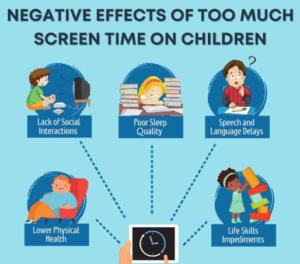
The Effect of Too Much Screen Time on Preschoolers
Today, mobile phones, TVs, and tablets are ubiquitous, and it has become hard for children to keep away from them. However excessive screen time can negatively affect the mental, social, and physical well-being of preschoolers. Let us learn about these three aspects in detail:
1. Cognitive Development: How Too Much Screen Time Affects Learning
Cognitive development is the capacity to learn, understand, and think. If children are exposed to much screen time, their brain growth can be hindered.
-Decline in Attention Span: Speedy colors and images on television screens automatically hook children, thus diminishing their concentration power and patience level.
-Impact on Imagination and Creativity: As soon as children make watching cartoons or videos a part of their daily routine, the brain’s power to think and create new thoughts is lost.
-Memory and Learning Problems: Studies state that too much screen time negatively affects memory and problem-solving ability. That is, children are alienated from actual learning.
Solution:
-Make kids read books, and solve puzzles and activities manually.
-Create the habit of studying toys and storytelling.
-There should be breaks in between screen time so that their brain gets relaxed.
2. Social Skills: The Effect on Communication and Emotional Intelligence
Social skills refer to speaking with friends, emotional understanding, and playing in the real world. If preschoolers spend too much time on screens, it can disrupt their social and emotional development.
-Face-to-face interaction gets less: When kids watch TV and mobile excessively, their face-to-face conversation skills are weak.
-Emotional Knowledge is diminished: Preschool children want to exhibit their feelings and comprehend others’ feelings. However, when they spend too much time on the screen, emotional intelligence does not grow.
-Tantrums and Behavioral Problems: Too much time on the screen can make kids cranky. They become frustrated or throw a tantrum when their screens are removed.

Solution:
-Engage children in interactive play, pretend, and group activities.
-Practice good eye contact and communication.
-Gradually make changes to decrease the usage of screens so that the child can get used to it.
3. Physical Health: Sedentary Lifestyle and Its Impact on Overall Well-being
Preschoolers’ physical health is highly crucial for their growth and development. Too much screen usage makes them inactive, which adversely affects their body as well as health.
-Obesity and Weight Gain: While children remain seated in front of a screen and watch TV, they slow down physical movements. This puts brakes on their metabolism and they begin to gain weight.
-Poor Posture and Eye Strain: Children begin developing back pain, neck pain, and eye strain as a consequence of watching screen for a longer duration.
-Sleep Issues: The screen’s blue light disrupts the children’s sleep cycle, which further impacts their thinking and learning abilities.
Solution:
-Incorporate outdoor play and physical activities in daily life.
-Switch off the screens an hour before sleeping so that they can sleep peacefully.
-Establish screen-free areas, including a dining area and bedroom.
How to Set Healthy Screen Time Limits for Preschoolers
1. Establishing a Screen Schedule with Clear Rules
If you want your preschooler not to sit in front of the screen too much, then you will have to make a proper screen schedule for him. If children have a routine, then they feel comfortable and they try to follow it, so if you give your child a fixed time to watch the screen, then he will know at what time he will get access to the screen and when not.
How to make a correct screen schedule?
-Set a fixed screen time – like only 1 or 2 times a day, and for a fixed duration (according to you, 1 hour per day is enough for preschoolers)
-Make screen time productive – Screen time should not be just for cartoons or games, but also for educational content.
-Include breaks – If your child is watching the screen for 30 minutes, then after that keep time for physical activity or creative play.
Example Screen Schedule:
Morning: 10-10:30 AM (Educational cartoon or interactive learning app)
Evening: 5-5:30 PM (Family co-viewing or story-based animated content)
After dinner: No screen time, only bedtime stories and relaxing activities
2. Creating Screen-Free Zones in the House
If you want to limit the screen time of your child, then you will have to create some screen-free zones for him in the house where there will be no screen, such as a screen-free area where TV, phone, tablet, etc. will not be used.
How to create screen-free zones?
No Screens on the Dining Table – Strictly forbid children from watching TV or using phones while eating. This habit of using phones while eating does not help children eat mindfully and hinders them from interacting with the family.
Make the bedroom a screen-free zone – exposure to screens while sleeping spoils the sleep quality of children. Therefore, keep children away from screens at least 1 hour before bedtime. To keep them away, you can make them listen to stories.
No screens in the Play Area and Study Zone – Do not use any screen at the place where your child plays or studies. This should not happen because it can distract him. For creativity, he needs to be fully focused.
3. Using the 20-20-20 Rule to Reduce Eye Strain
If children are watching mobile, TV and their screen time is getting too much, then you, as a parent, need to take care of this thing. Due to long-time screen exposure, they can have eye strain, headache, or focus issues. So to solve this, you can limit screen time and can also follow the 20-20-20 rule.
What is the 20-20-20 Rule?
After every 20 minutes of watching a screen, ask your child to look at something 20 feet away for 20 seconds. This is the simplest and most effective technique to relax the eyes.
How to apply it?
If your child is watching TV, ask him to look out of the window at a tree or the sky after every 20 minutes.
If he is using a mobile or tablet, encourage him to close his eyes or look into the distance for 20 seconds.
Apply this rule while reading and coloring, so that the eyes do not get strained due to continuous focus.
Encouraging Screen-Free Activities for Preschoolers
It has become very difficult to avoid screens these days, but it is equally important that you can develop the interest of children in engaging in fun activities due to which the screen will stay away for some time. Here are some best screen-free activities that you can prefer for both indoor and outdoor environments.
Fun and Engaging Indoor & Outdoor Play Ideas
Indoor Activities:
-Building Blocks and LEGO – Children’s imagination and problem-solving skills improve.

-Role Play Games – Role-playing games like “Doctor-Doctor“, “Teacher-Student” or “Shopkeeper” boost creativity.
-Board Games & Puzzles – The best way to improve memory and cognitive skills.
Outdoor Activities:
-Nature Walks and Treasure Hunt – Fun way to take kids out into nature.
-Cycling and Running Games – Perfect for physical fitness and energy release.
-Gardening – Spending time with plants teaches kids responsibility and patience.
Encouraging Hobbies Like Drawing, Storytelling, and Pretend Play
Drawing & Crafting:
Let the children play with colors, crayons, paints, and stickers. This will develop their fine motor skills and will also help them focus on their childhood. You can give them weekly art challenges in which they will draw things of their choice and show them to you.
Storytelling Time:
-Read or make Bedtime Stories – tell the childhood stories in your own words.
-Do Puppet Shows – you can make a small puppet theater and make the children act out the stories.
Pretend Play & Dress-up:
-Children can gain new experiences by becoming “Superheroes”, “Doctors”, or “Chefs”.
-Kitchen play sets or toolbox toys can teach them real-world skills.
How to Involve Preschoolers in Household Activities to Limit Screen Dependence
Involving children in household chores gives them a sense of responsibility and automatically reduces their screen cravings.
Easy Household Tasks for Preschoolers:
-Toy cleaning race: Tell them that whoever cleans their toys the fastest will get a reward.
-Watering plants: Give them a unique plant of your own so that they can water it daily.
-Helping in the kitchen: helping in kneading the flour, washing the vegetables, or assisting in cutting the fruits – these activities keep them busy and there is less use of the screen.
Conclusion
Managing screen time for preschoolers doesn’t mean eliminating it completely—it’s all about finding balance. By setting healthy limits, choosing quality content, and encouraging real-world activities, parents can create a healthy digital routine for their children. Start making small changes today, and see how it benefits your child’s development!